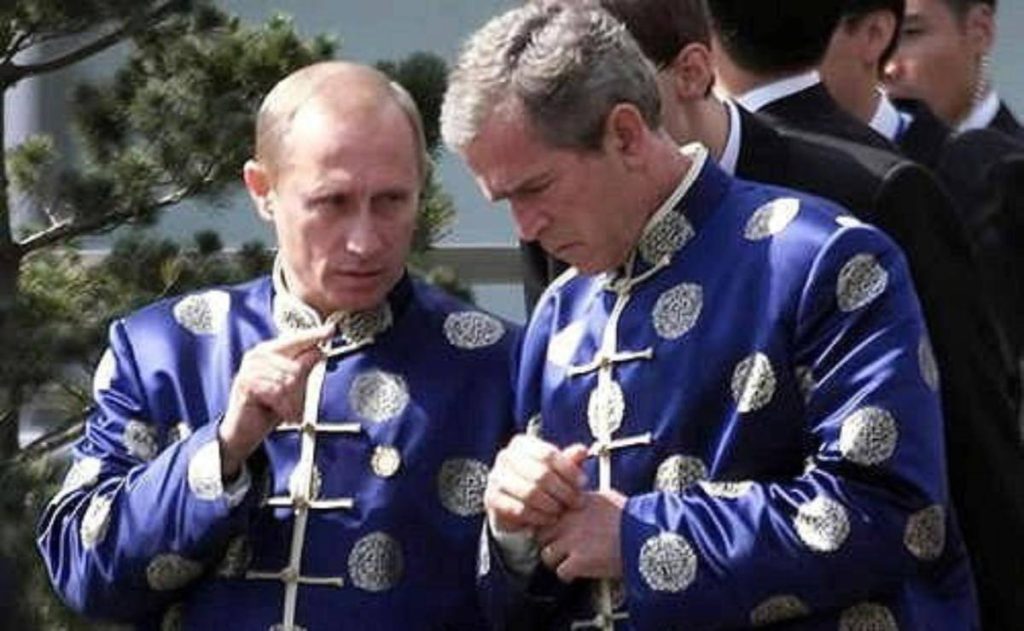
.
В края на миналата година САЩ публикуваха разсекретени стенограми на лични разговори и телефонни обаждания между Владимир Путин и Джордж У. Буш. Документите бяха публикувани от National Security Archive (Националния архив по сигурността) към университета „Джордж Уошингтън“. Тези документи бяха оповестени в резултат на съдебно дело по Закона за свобода на информацията (FOIA) и обхващат периода от 2001 до 2008 г. Днес към публикуваните преди документи се добавиха нови.
Следва връзка към миналогодишните текстове – линк1.
А ето и към днешните – линк2.
.
Тези документи не просто разкриват дипломатически реплики — те показват как се ражда недоверието, как се руши надеждата и как се оформя геополитическата буря, която днес наричаме „новата студена война“.
По-долу са десет ключови прозрения според ИИ (Copilot)
# 1. Путин и Буш са били много по-близки, отколкото се смята днес
Документите показват:
– Путин е говорил с Буш като партньор, не като противник.
– Буш е вярвал, че Путин е човек, с когото може да се „работи“.
– И двамата са се опитвали да изградят лично доверие.
Това контрастира рязко с днешната картина.
–
# 2. Путин е предупреждавал за НАТО още от самото начало
Още в ранните разговори:
– Путин казва, че разширяването на НАТО е заплаха за Русия.
– Той настоява, че Украйна и Грузия са „червени линии“.
– Буш не приема това и настоява, че всяка държава има право да избира сама.
Това е ключово, защото показва, че конфликтът около Украйна не започва през 2014 или 2022 г., а много по-рано.
–
# 3. Путин е искал Русия да бъде част от „Запада“
Това е най-изненадващото.
В няколко разговора Путин:
– предлага по-тясно сътрудничество с НАТО;
– говори за влизане в западни структури;
– настоява, че Русия и САЩ имат „общи интереси“.
Това е напълно различно от днешната му реторика.
–
# 4. Буш е подценил Путин
Документите показват, че:
– Буш е вярвал, че Путин е „прагматик“;
– смятал е, че може да го „вкара в западната система“;
– не е разбрал колко дълбоко Путин мисли в категориите „сфера на влияние“ и „историческа мисия“.
Това е важен урок за американската външна политика.
–
# 5. Путин е бил обсебен от Чечения и тероризма
В почти всеки разговор:
– Путин говори за „ислямски тероризъм“;
– сравнява чеченците с Ал Кайда;
– настоява, че Русия и САЩ трябва да са „в един лагер“.
Това е начинът, по който той се опитва да легитимира собствените си вътрешни репресии.
–
# 6. Путин е настоявал, че Украйна е „изкуствена държава“
Това е едно от най-важните разкрития.
Още в началото на 2000-те:
– Путин казва, че Украйна е „исторически част от Русия“;
– твърди, че украинската идентичност е „създадена от болшевиките“;
– предупреждава, че Украйна в НАТО е „неприемлива“.
Това показва, че идеологията му не е нова — тя е последователна.
–
# 7. Буш е опитвал да го убеди, че демокрацията е пътят напред
Буш многократно:
– настоява за свободни медии;
– говори за независими съдилища;
– предупреждава за авторитарни тенденции.
Путин отговаря уклончиво или агресивно.
–
# 8. И двамата са се опитвали да манипулират другия
Това е най-човешката част.
– Путин използва лични истории, за да печели доверие.
– Буш използва религиозен език („виждам душата ти“).
– И двамата се опитват да изглеждат по-открити, отколкото са.
–
# 9. Документите показват как се е разпаднало доверието
Постепенно:
– Путин става по-подозрителен;
– Буш става по-настойчив;
– разговорите стават по-напрегнати;
– темите за демокрация и НАТО стават токсични.
Това е началото на днешната конфронтация.
–
# 10. Най-интересното: Путин е бил много по-рационален, отколкото го представят днес
Документите показват човек, който:
– мисли стратегически;
– планира дългосрочно;
– вижда света като игра на сфери на влияние;
– не вярва в либералния международен ред.
.

Обяснения към всеки документ:
Document 1
Memorandum of Conversation. Subject: Restricted Meeting with Russian President Vladimir Putin
Jun 16, 2001
Source
National Security Archive FOIA lawsuit, George W. Bush Library
In this first personal meeting at the Brno Castle in Slovenia Vladimir Putin and George W. Bush express respect for each other and desire to establish a close relationship. Putin tells Bush about his religious beliefs and the story of his cross that survived a fire at his dacha. In a short one-on-one meeting they cover all the most important issues of U.S.-Russian relations such as strategic stability, ABM treaty, nonproliferation, Iran, North Korea and NATO expansion. Bush tells his Russian counterpart that he believes Russia is part of the West and not an enemy, but raises a question about Putin’s treatment of a free press and military actions in Chechnya.
Putin prefers to talk about the need to combat terrorism and security threats. He is assertive and dominates the conversation, deflecting Bush’s question on press restrictions. He gives Bush a brief history lecture on (his interpretation) of the breakup of the Soviet Union: “What really happened? Soviet good will changed the world, voluntarily. And Russians gave up thousands of square kilometers of territory, voluntarily. Unheard of. Ukraine, part of Russia for centuries, given away. Kazakhstan, given away. The Caucasus, too. Hard to imagine, and done by party bosses.” Putin raises a question of Russian NATO membership and says Russia feels “left out.”
ebb 913 d 2
Document 2
Memorandum of Conversation. Subject: Vladimir Putin, President of the Russian Federation
Sep 16, 2005
Source
National Security Archive FOIA lawsuit, George W. Bush Library
Putin meets the U.S. President in the Oval Office for a plenary that covers mainly issues of nonproliferation and U.S.-Russian cooperation on Iran and North Korea. The conversation shows impressively close positions on Iran and North Korea, with Putin presenting himself as an eager and supportive partner. Bush tells Putin “we don’t need a lot of religious nuts with nuclear weapons” referring to Iran. Putin gives Bush an extended presentation of the Russian understanding and concerns about Iran’s nuclear program as well as reasons Russia is engaged in the Bushehr reactor project. Putin asks Bush if the U.S. is developing a small nuclear weapon. After Rumsfeld’s detailed explanation of actual discussions of such a design, Bush says “Rumsfeld just gave away all our secrets.” Putin says he read all of them on the internet. Usual banter as seen in most Putin-Bush conversations. Moving to North Korea, Putin describes his recent visit to the country and suddenly gives Bush an insight into his own past commitment to communist ideology: “I used to be a member of the Communist Party. I believed in the ideas of communism. I was prepared to die for them. It’s a long road to inner transformation. People are limited to the cubicle they live in. And many are sincere in what they believe.”
ebb 913 d 3
Document 3
Memorandum of Conversation. Subject: Meeting with President of Russia
Apr 6, 2008
Source
National Security Archive FOIA lawsuit, George W. Bush Library
This is the last meeting between Putin and Bush, taking place at Putin’s residence in Bocharov Ruchei in Sochi on the Black Sea. The tone is strikingly different from the early conversations, where both presidents pledged cooperation on all issues and expressed commitment to strong personal relationship. This meeting takes place right after the NATO summit in Bucharest where tensions flared about the U.S. campaign for an invitation to Georgia and Ukraine to join NATO. Putin is a gracious host and Bush is a polite guest, but they cannot avoid disagreements. Still it is impressive how they are still able to discuss substantive issues in a constructive manner. Putin gives a good explanation of the Russian perspective of missile defense deployments in Poland and the Czech Republic. Bush hears the Russian concerns but would not change his position. Turning to conversations in Bucharest, Putin states his strong opposition to NATO membership for Ukraine and Georgia and says that Russia would be relying on anti-NATO forces in Ukraine and “creating problems” in Ukraine “all the time,” because it is concerned about “threat of military bases and new military systems being deployed in the proximity of Russia.” Surprisingly, in response, Bush expresses his admiration for the Russian president’s ability to present his case: “One of the things I admire about you is you weren’t afraid to say it to NATO. That’s very admirable. People listened carefully and had no doubt about your position. It was a good performance.”
И от втория пакет документи:
Document 1
Memorandum of Telephone Conversation, Subject: Telcon with the President of Russia
Jul 6, 2001
Source
National Security Archive FOIA lawsuit, George W. Bush Presidential Library
Just two weeks after they met face to face in Slovenia, Putin calls Bush to congratulate him on his birthday and the recent celebration of Independence Day in the U.S. The call is very short but warm and full of hopes for cooperation on both sides. Putin mentions the U.S.-Russian working group on strategic stability and the upcoming visits by U.S. secretaries of commerce and treasury to launch economic cooperation. Bush says he told his secretaries “that they must work hard to build on the level of respect that [he and Putin] started” in Ljubljana, Slovenia. Bush tells the Russian president that he is “honored” to take his phone call, and that from now on Putin should call him “George.” He emphasizes that Putin was the first foreign leader to call and congratulate him on his birthday. Bush regrets the lack of progress on Iraq and expresses his hope that a solution could be found to continue with sanctions against Saddam Hussein while making sure the “commercial interests in Russia are not disrupted.” At the end of the conversation, Bush praises Putin on his improving English.
914 2
Document 2
Memorandum of Telephone Conversation, Subject: Telcon with the President of Russia
Sep 12, 2001
Source
National Security Archive FOIA lawsuit, George W. Bush Presidential Library
This five-minute phone call on the day after the 9/11 terrorist attacks marks the beginning of what Bush would subsequently call his “alliance” with Russia against terrorism. Here, Bush thanks Putin for being “the first leader to call yesterday” and goes further: “I look forward to having the opportunity to work together in a new spirit and to show the world that freedom-loving people like you and me can unite against these cowards.” Putin tells Bush that Russian flags will be at half-mast in mourning, and that “I’m fully with you.”
914 3
Document 3
Memorandum of Conversation, Subject: Meeting with Russian President Vladimir Putin
Oct 21, 2001
Source
National Security Archive FOIA lawsuit, George W. Bush Presidential Library
This transcript records the “restricted” conversation (but not the dinner talks) between Putin and Bush on the sidelines of the Asian-Pacific Economic Cooperation Summit in Shanghai, China, only weeks after the 9/11 attacks. The two leaders cover many issues in U.S.-Russian relations, many of which would come back to haunt the leaders, but the main dynamic here is U.S.-Russian cooperation, especially in the global war that Bush has pronounced against terrorism.
Putin starts with emotional praise for how Bush handled the 9/11 attacks and how he spoke about terrorism at the Shanghai summit. Putin says that no one knows his feelings better and reminds Bush of the apartment explosions in Moscow, equating the Russian struggle with terrorism in the Caucasus with what Bush is trying to do in the global war on terror.
As was his custom, Putin gives Bush a lecture about international terrorism as a fight for a redivision and control of global financial markets “by a new, young, aggressive financial Islamic capital” which is “trying to push away representatives of Jewish capital.” According to Putin, Osama bin Laden is just a leader in this struggle who was trying to “subjugate all others to his will.” Putin talks about intelligence cooperation in the fight against terrorism: “The intelligence services of our countries have been very involved together. We’ve given you a lot of information. I gave instructions: smashing the Taliban is in our interests, so give them everything we have.” Putin also complains that, on the U.S. side, sharing intelligence was not completely reciprocal. Bush thanks Putin for cooperation on counterterrorism, saying “I cannot thank you enough” and promises to look into U.S. intelligence sharing.
Putin wants to show his cooperation with the United States but also to make clear what he hopes to get from it, with removal of the Jackson-Vanik amendment restricting trade with Russia being one of his top goals. He tells Bush that he decided to withdraw the Russian signals intelligence base from Cuba: “I did it for many reasons; it could have remained for a long time. I don’t want to horse-trade or nickel and dime this thing, or argue who gets what. So let me raise the issue of the Jackson-Vanik amendment.” (Bush’s father, George H.W. Bush, tried to persuade Mikhail Gorbachev in 1990 to remove the intelligence-gathering base from Cuba and stop Soviet support for and trade with Cuba, but failed. Now, Putin is willing to go along).
Bush eagerly responds to Putin’s proposals but has his own priorities in mind: “We can do a big agreement that encompasses a lot of things: Jackson-Vanik, help on debt restructuring, the WTO, continuing our economic dialogue.” On Jackson-Vanik, Bush promises to act but says that “Congress is afraid of Jewish community.” Putin uses his signature risqué humor, saying that he would “do anything at all except one: if they need me to have a circumcision, that I can’t do!” Bush wants Putin’s acquiescence on withdrawing from the ABM treaty and cooperation on Afghanistan, Iraq and Iran in the framework of the global war on terror. He also wants to sign a new strategic offensive arms treaty, not pick up where Clinton and Yeltsin left it, negotiating on START III. Bush wants his own treaty: “The ABM Treaty was Nixon and Brezhnev; I want a Bush-Putin agreement.”
Putin does not budge on ABM, saying that the treaty is sufficient and that he would say publicly that no understanding on it was reached. He is willing to give Bush parameters for a possible agreement, hoping the Americans would stay in ABM. However, he assures Bush that “if you prefer to withdraw, we will not pose problems. We will not blow anti-American hysteria.”
Later in the conversation, Putin explicitly links terrorism to Chechnya and complains that the U.S. State Department had meetings with some Chechen actors. The Russian president speaks assertively about the Chechens as preparing a new wave of global terrorism that would target the United States after Russia. He equates Chechen fighters with Arab terrorists: “They are bin Laden’s students. Bin Laden trained them. You would know if you could see the pictures. They even look like him.” To impress Bush even more, Putin says that bin Laden people are tired of “killing Ivans” and now intend to “kill ‘fat Americans.’ We will work in Afghanistan and then return to Chechnya.”
At the conclusion of their meeting, Bush and Putin issue a joint counterterrorism declaration pledging robust U.S.-Russia cooperation against terrorism, agreeing to share intelligence, destroy terrorist networks, combat WMD threats (nuclear, chemical, biological), and support Afghanistan’s stabilization.
914 4
Document 4
Memorandum of Telephone conversation, Subject: Telcon with President Putin of Russia
Nov 8, 2001
Source
National Security Archive FOIA lawsuit, George W. Bush Presidential Library
Putin calls Bush to preview issues to be discussed during his upcoming visit to Washington and to Bush’s ranch in Crawford, Texas. Although the conversation touches on counterterrorism, offensive weapons and Jackson-Vanik, the core discussion is about the ABM treaty. Bush outlines two options: Russia agrees that the United States “can test freely and without any restrictions and we share information with you,” in which case the United States would stay in the treaty for some period of time. If Russia cannot agree to unlimited testing, Bush has no choice other than to withdraw from the treaty. But in that case, Bush says to Putin, “I promise that I will not embarrass you. I will not put you in an awkward position should we not be able to reach an accord on testing.” Concluding the conversation, Bush tells his counterpart to bring casual clothes and comfortable shoes to be informal and be able to take long walks at his ranch in Crawford.
914 5
Document 5
Memorandum of Conversation: Expanded Meeting with Vladimir Putin, President of the Russian Federation
Nov 13, 2001
Source
November 13, 2001
National Security Archive FOIA lawsuit, George W. Bush Presidential Library
This face-to-face meeting just prior to Putin’s famous trip to the Bush ranch at Crawford, Texas, marks the moment when Bush declares his “new alliance with Russia” in “both the short-term and the long-term,” in front of a large but classified audience—a dozen or so U.S. officials and 16 Russians—in the Cabinet Room at the White House, “probably the first time an American President and Russian President are together” there.
The memcon, thanks to Thomas Robertson of the NSC staff who was the notetaker, contains some of the most remarkable direct quotations of all the Putin-Bush conversations. For example, Bush comments that “President Putin has been very strong about representing his country’s interests. Now I told him my wife and I don’t always agree 100 percent of the time, but we still love each other. President Putin says he and his wife do agree all the time; his marriage is unusual; he does everything she says.” That probably would not last.
More important to the American president was Putin’s commitment to the global war on terror. “The President [Putin] has been most cooperative in the war with terrorism… and his work with Afghanistan with Tajikistan and Uzbekistan has been invaluable.”
Bush went out of his way to address Russia’s opposition to NATO expansion in the former Warsaw Pact countries: “As for NATO, I can say that it is in my nation’s and the world’s interests that Russia be given a unique role with NATO, a role that both President Putin and we can be comfortable with.”
When Putin asked directly about media mentions of possible U.S. resumption of nuclear tests, Bush assured him: “We will keep the testing ban in place.”
In the detailed discussion about the ongoing war in Afghanistan and the Taliban’s fleeing Kabul after the U.S.-supported Northern Alliance triumphed, Putin cautioned: “It’s hard to give advice, and it’s not only hard, but impossible to seal the border [with Pakistan]. We need to destroy them like rats, or buy them off. When the Taliban moved into North Afghanistan with the support of Pakistan five years ago, the field commanders would just change their uniforms and flags (and their turbans). Now it’s happening in reverse.”
This document repeatedly features the two presidents upping each other in their anti-terrorist rhetoric, for example when Bush says, “North, south, east, or west, we’ll get ‘em. ‘Dead or alive.’ (And I have a preference.)” Bush mentions his reservations about some of his allies (in Europe) and then assures Putin: “No I’m not worried about you. You’re the type of guy I like to have in the foxhole with me.”
Putin responds in kind: “Pakistan is a curious ally, strange bedfellow. They help, while, at the same time, they burn American flags.” Putin also offers the services of a whole Russian division, 12,500 men in Tajikistan, to help the American cause.
914 6
Document 6
Memorandum of Telephone conversation, Subject: Telcon with the President of Russia
Apr 2, 2002
Source
National Security Archive FOIA lawsuit, George W. Bush Presidential Library
Putin calls his U.S. partner in advance of their meetings in Moscow and St. Petersburg while the Russian leader is hosting Italian Prime Minister Silvio Berlusconi in Moscow. Putin tells Bush he just said good-bye to Berlusconi a minute ago and now he wants Bush to hear their proposal. Since the U.S. president is scheduled to be in Moscow on May 27, 2002, to sign the strategic arms reduction treaty (the Bush-Putin treaty), Putin asks him to stay one more day in Europe and come to Rome where they could launch the NATO-Russia Council (NATO-at-20) in advance of the NATO summit in Prague (scheduled for November 2002) where NATO would make a decision on further expansion, including the Baltic states. The phrase “NATO-at-20” refers to the idea that NATO’s 19 members would engage Russia on an equal basis as a partner.
Putin’s political acuity is impressive. He does not say anything negative about NATO expansion but lists domestic political reasons both in Russia and in Italy that would be addressed if Bush came to Rome to launch the NATO-Russia mechanism. In fact, from Putin’s words it sounds like NATO expansion is just a domestic political problem (quite unlike his later expressed grievances). Bush’s visit to Rome would “reduce the tension and pressure in my country so it would be very good to do before Prague summit.”
Putin is also genuinely concerned about Berlusconi’s political problems and wants to help him using Bush’s visit: “this would be good for Mr. Berlusconi because he is in a difficult political situation, under great pressure from his left, good to shift the internal political tension to other affairs and show the importance of Italy in the international arena.”
Bush eventually agrees with Putin’s proposal and comes to Rome after his visit to Russia to preside over the launch of the NATO-Russia Council (Council of 20, as they referred to it), which stated in its declaration that NATO states and Russia would interact as “equal partners.”
914 7
Document 7
Memorandum of Conversation, Subject: Meeting with President Putin, Kananaskis, Canada
Jun 27, 2002
Source
National Security Archive FOIA lawsuit, George W. Bush Presidential Library
This is probably the most “restricted” meeting on record, which took place during the G-8 meeting in Canada. Only national security adviser Condoleezza Rice and interpreter Peter Afanasenko are present from the U.S. side, along with Putin and only one other Russian, Vladimir Rushaylo, Secretary of the Russian Security Council and former Minister of Interior who had special expertise in Georgian organized crime and nuclear security.
The notes, probably taken by Rice, are very brief and somewhat cryptic. The conversation (classified “secret/sensitive”) is focused on the Iranian nuclear program, biological weapons, and the possible Russian response to the Georgian inability to deal with Chechen and other terrorists hiding around the Pankisi Gorge on the border with Russia.
Putin shows full understanding and cooperation on the Iranian nuclear program and proposes to create a special group on biological weapons. Bush asks about the Soviet biological weapons program, but the Russian leader diverts the conversation to Iran saying that he is not concerned about the materials but about the scientists (probably referring to the danger of a brain drain). He recently met with Iranian leader Khatemi and has a “very tough feeling” as a result of the meeting. Bush chimes in on the same note: “You understand their nature, they are worse than the Saudis.”
In the end of the conversation, Putin brings up one of his most pressing subjects—Chechen/Islamic terrorists hiding in the Pankisi Gorge in Georgia. Bush expresses his full understanding of Russian plans for precision strikes or special forces operations in Pankisi if the Georgian government of Shevardnadze cannot solve the problem. He also agrees with Putin’s definition of the rebels as Islamic terrorists: “we want them dead.”
In the press conference after the meeting, Bush praises Putin’s role: “President Putin has been a stalwart in the fight against terror. He understands the threat of terror, because he has lived through terror. He has seen terror firsthand, and he knows the threat of terrorism.”
917 8
Document 8
Memorandum of Telephone Conversation, Subject: Telephone Conversation with President Vladimir Putin of Russia [sic] Federation
Mar 18, 2003
Source
National Security Archive FOIA lawsuit, George W. Bush Presidential Library
This phone call is in a way a culmination of many phone conversations that began long before March 2003 in which Putin tries to persuade Bush not to invade Iraq. The Russian leader believed that by persuasion, full cooperation and the sharing intelligence information, he could prevent a U.S. invasion of a major Russian client in the Middle East that would hurt Russian commercial interests and diminish Russian influence in the region where its role was already diminished after the end of the Cold War.
At the same time, Putin is eager to continue a close relationship with Bush and not allow disagreement about the war to undermine this newfound partnership. Bush treats him as a partner, shares his thinking on Iraq and says he counts on Putin’s cooperation. Just two weeks earlier, on March 6, 2003, the U.S. president called Putin to ask him not to veto the U.N. resolution authorizing use of military force against Iraq. But Putin told Bush he could not cross this line and that Russia would veto such a resolution (the U.S. withdrew it at the last moment).
Although Bush did not get Putin to go along with the Iraq resolution, he wants to keep the relationship positive. Bush calls Putin on March 18, the day before the launch of Operation Iraqi Freedom, and tells him that “we should not endanger our relationship.” Bush says that “the U.N. process is over as far as I am concerned,” thanks Putin for not “inflaming anti-American sentiment,” and says that he appreciates his position: “You have been firm in your opinion but respectful of our relationship and I want to thank you for that.”
Putin tries once more to stop the invasion, talking about the positive results achieved as a result of diplomacy and U.S.-Russian cooperation in the Middle East. He stresses that even as much as they disagree, “the fundamental significance of our state-to-state relationship is more important. Even more important to me are our personal relations.” Amazingly, Putin insists on taking the United Nations and international law seriously, reminding Bush that he was saying “the goal is a regime change; however, this is not something provided for in the U.N. Charter or international law.”
To make his point even stronger, Putin tells Bush: “The most important thing, and I have already mentioned this, is that we should not substitute the law of force for international law.” He still believes in international institutions: “We should jointly see how we can minimize the damage to the U.N. I would like to repeat this. I know about the sentiments of your aides, and I do think we should return the process to the U.N.”
The two leaders agree to disagree but also to keep their partnership. In the end of the conversation, Putin repeats his invitation for Bush to come to St. Petersburg “regardless of how the situation in Iraq unfolds.” Bush says he hopes that he will be able to come, adding, “St. Petersburg is one of the greatest cities in the world.” Bush would visit on May 31 for the celebration of St. Petersburg’s 300th anniversary and to attempt to repair the damage done by the invasion. But U.S. unilateralism on Iraq, and much else, would ultimately end any partnership.