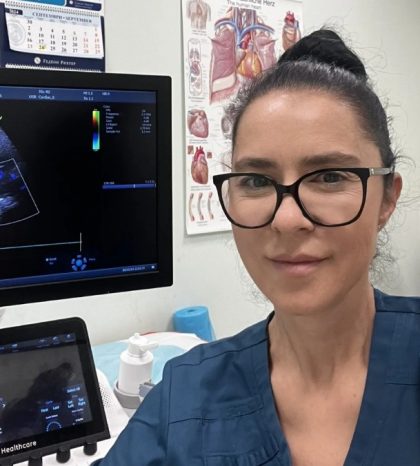
Prof. Nevena Ivanova. Photo: Personal archive
.
U.S. Federal Government Funds Research on a Genetic Variant
First Reported by Assoc. Prof. Nevena Ivanova
The discovery by Bulgarian cardiologist and university faculty member Assoc. Prof. Nevena Ivanova has been taken forward in research conducted by leading U.S. scientists from the National Institutes of Health (NIH) and published in the prestigious scientific journal PNAS.
In 2024, Assoc. Prof. Nevena Ivanova, MD, PhD, was the first to report the FGF23 c.202A>G (p.Thr68Ala) genetic variant in the international scientific literature, identified in a patient with a rare inherited disorder. At the time of publication, the variant was classified as a Variant of Uncertain Significance (VUS); however, Assoc. Prof. Ivanova proposed that it may have a pathogenic role.
The variant was subsequently included in an experimental study conducted by a U.S. research team involving scientists from the National Institutes of Health (NIH) — one of the world’s leading biomedical research institutions, with approximately $47.5 billion in funding for fiscal year 2026. The study was supported by the Intramural Research Program of the National Institute of Dental and Craniofacial Research (NIDCR), part of the NIH. The findings were published in 2026 in the Proceedings of the National Academy of Sciences (PNAS).
Among the authors are Michael T. Collins, an internationally recognized researcher in rare bone and mineral metabolism disorders, and Kelly G. Ten Hagen, an NIH research group leader specializing in the molecular mechanisms of glycosylation.
The U.S. research team incorporated the genetic variant originally reported by Assoc. Prof. Ivanova into a specially developed experimental system. The investigators employed gene cloning of patient-derived mutations in FGF23 and GALNT3, expression systems, and advanced proteomic approaches, including mass spectrometry.
The experiments demonstrated that the FGF23 p.Thr68Ala variant impairs the stability and secretion of the FGF23 protein. These findings provide functional evidence supporting the Bulgarian cardiologist’s original hypothesis regarding the pathogenic role of the variant. The U.S. researchers explicitly cite Assoc. Prof. Ivanova’s original publication.
Of particular significance, Assoc. Prof. Ivanova was the sole author of the original clinical report. Even before the publication of the U.S. study, the case had received positive scientific attention from specialists affiliated with Harvard Medical School, where Assoc. Prof. Ivanova completed additional training in genetics. In 2025, she also presented her discovery at the Annual Meeting of the American Society of Human Genetics (ASHG) in Boston.
International recognition of Assoc. Prof. Ivanova’s scientific work is further reflected in her invitation to full membership in Sigma Xi – The Scientific Research Honor Society, of which she has been a member since 2024. Founded in 1886 at Cornell University in the United States, Sigma Xi is one of the oldest and most respected international scientific honor societies. Membership is by nomination and is based on scientific achievement and research contributions. Throughout its history, the Society has included distinguished scientists such as Albert Einstein, Enrico Fermi, Francis Crick, and James Watson, and more than 200 Nobel laureates have been among its members.
The convergence of the original Bulgarian clinical discovery with the experimental findings of leading U.S. scientists advances our understanding of the molecular mechanisms underlying rare inherited disorders of phosphate metabolism and lays a scientific foundation for the future development of innovative, molecularly targeted therapeutic strategies. It is a compelling example of the potential of Bulgarian medical science to contribute to research of global significance.
.